
FRS 102 for SME’s – What steps need to be taken?

You’ve read all the technical literature, you may have even read the standard. Your advisers have told you that FRS 102 is coming and you know that there will be changes. After all that one big question remains – how do you move from the theoretical to the practical adoption of the standard. This is not just about understanding the technicalities and changes, it is about putting the technical issues into practice and embedding them into your organisation for the long term. This paper will help you.
FRS 102 has been talked about for some time, it has arrived and now is the time to act. The implementation date is for accounting periods beginning on or after 1 January 2026, so it has already arrived and if you are a 31 December reporter, your first set of accounts will be those with a 31 December 2026 year end.
There are two main impacts of the standard, revenue recognition and leases. Whilst revenue recognition is going to be more impactful for a handful of industries, lease accounting is likely to have an impact on a significant majority of SMEs. New disclosure requirements will impact smaller companies that have previously been able to take advantage of disclosure exemptions.
FRS reporters in the UK have an advantage over their IFRS reporting counterparts. The similar standards (IFRS 15 for revenue recognition and 16 for leases) for those reporters have been in effect for a number of years, meaning there is a wealth of experience that we can draw on when thinking about the new requirements of FRS 102.
The conversion process – a simplified flowchart
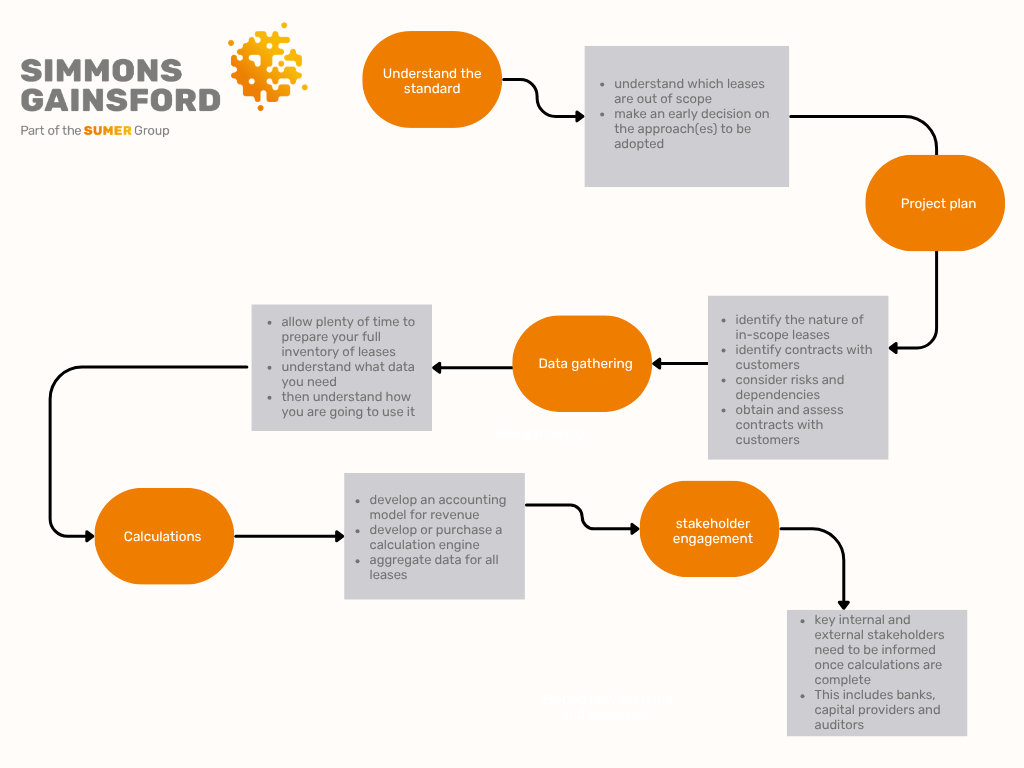
1. Understand the standard and the simplifications you can take advantage of.
Understanding the standard in sufficient detail to be able to assess the impact on your business is important, to properly scope and plan your implementation project and identify project risks.
FRS 102 provides a few simplifications which SMEs will most likely want to take full advantage of. The first of these is the extent to which leases are out of scope. Short-term leases and many low-value asset leases can be excluded, but significant leases such as property, vehicle and equipment leases will usually be in scope.
There are also options for the manner in which the transition is presented which will have an impact on the scope of your project. The standard allows for a full retrospective approach for revenue (not leases), likely to be more complex but if trends are important, preferable, or a modified retrospective approach (mandatory for leases and optional for revenue). An early decision on the approach(es) to be adopted will help frame the scope of the project plan.
2. Develop a project plan
Any project plan should start with a high-level impact assessment. The objective of the assessment is to enable you to identify where the challenging areas are likely to be and allocate time and resources accordingly. For SMEs this is likely to be a straightforward exercise focussing on:
• Identifying the nature of in-scope leases (property, plant & machinery, etc), and the volume of leases to be processed. With leases, there is already financial disclosure of the operating lease commitments which will give you some idea as to the scope of the project. At this stage, approximate numbers will suffice.
• Identifying contracts with customers, the nature of performance obligations and therefore considering the extent to which your revenue recognition model will change. For certain industries where services are bundled, the assessment is likely to be more complex. Those businesses include but are not limited to construction, manufacturing, SAAS / technology, recruitment, healthcare and property. For an initial assessment, this could be done at a high level “grouping of contracts” level.
• The extent to which disclosure exemptions are no longer available, and therefore how much effort is likely to be required to obtain the required data.
Another key consideration is stakeholder engagement, including investors and lenders. Plan to manage expectations and where lenders are involved with covenants, identify whether any covenants will be impacted by the changes in the financial accounts that the standard will cause.
Consider risks and dependencies. A risk could be the volume of complex leases, or poor document retention of leases, which could increase the timelines. Are you dependent on third parties for data? Do you have an accountant who prepares your financial statements? Understand what their needs are. Determine whether you will perform the work in-house or whether you will pass the work on to third parties. Determine whether you will develop a model in-house (unlikely), purchase a model, or look for free software online.
Once you have a good understanding of the environment in which you will be working, how you will work through the adoption and the volume and nature of work, you can develop a project plan and identify the resources to do the work. If you are a small entity with only a couple of in-scope leases, project planning will be straightforward, informal, and be accomplished in a short space of time. For entities with significant volumes of complex leases, project planning may take place over several weeks and be more formal.
Practical advice in developing your plan:
•The completion date is not “a few days before we sign off on the annual financial statements”. We would recommend that the completion date for the project is well before your year end to give you time to update your ledgers and close your books using the new standard. Otherwise, you will need to revert to top side adjustments and the challenges of putting adjustments into next year’s opening balances, which can be messy and prone to error.
•Be realistic in the amount of time each aspect of the changes will take and determine whether you will work on them in series or parallel. This is where the impact assessment information comes in. Have regard to the other time demands of people working on the changes, and whether records will be easy to access.
•A risk assessment (what could go wrong) will be valuable in determining the amount of time required.
•The downstream impacts of the standard, as well as the impact on the financial statements, means that a generous lead time for conversion is required. Rather, the deadline you set for completion will be dependent on the uses to which your financial statements are put. Having the data to work through these issues is likely to be the determining factor in your timetable.
- The requirements of FRS 102 will impact EBITDA (including for the restated year), balance sheet ratios, gearing and net debt. For example, if you have banking covenants, ratios will change and these will need to be updated into existing arrangements.
- If there are compensation plans that are impacted by the adjustments, these may need to be reworked or renegotiated. Challenges arose where changes to the arrangements occurred at the same time.
•This timeline should build in enough time for the prior year numbers to be restated for the leasing impacts. This will include the primary statements, accounting policies and note disclosures. This will make the preparation of the current year financials much easier to accomplish within your defined timelines.
3. Gathering and using the data
Depending on the nature of your business, especially the number of leases you hold, allow plenty of time to prepare your full inventory of leases. The same is true for revenue recognition, although it should be straightforward to find the contracts with customers, but there can be many of them. Grouping them into type is the practical way to approach this data gathering phase.
The basis for implementation for an SME is an understanding of what data you need and then understand how you are going to find it (this could be a risk factor, based on our previous experience). AI can calculate in matter of seconds, it will tell you that the data you will need includes:
- Lease details
- Lease payment schedules, including variable payments, incentives etc
- Discount rates.
This data will be used to calculate the day one measurements of the asset and liability, subsequent measurement and disclosures.
Depending on the number of leases involved, OCR and AI can be useful tools for the extraction of the relevant data from underlying contracts. OCR will come up with extracts from contracts from which you will need to determine the appropriate inputs into models. Use of AI goes further and can form judgements about how to input that data into models. As such uses of AI come with a health warning, proceed with caution. Any answers it comes up should be reviewed carefully and with a degree of scepticism, particularly when it comes to reviews of legal and accounting principles and judgements.
Based on this, you may well conclude that the only data you need is the lease, but experience shows that leases can be difficult to locate, especially those entered some time ago, and payment schedules which incorporate variable payments can be even more elusive. Lease updates are not always built into new contracts so a degree of excavation may be required to determine the current contractual terms.
Calculating discount rates is not usually possible based only on the lease. The rate used should be that inherent in the lease at inception. An alternative is to use the borrowing rate of the lessee. For first time adoption, there is a short cut that allows use of the obtainable borrowing rate (OBR). This is the rate at which the company could borrow the same amount of money over the same term as the lease. For SME’s this is a useful short-cut and unless other rates are readily available, for SME’s, we expect this default position to be widely adopted.
4. Calculating and implementing the changes
Revenue
The key challenge will be to determine the performance obligations and allocate revenue across the performance obligations. Depending on the business and the nature of contracts this could be complex. The standard acknowledges various revenue types each of which may result in a different model, variable consideration and discounting arrangement being areas which may require additional consideration. Further, it may be necessary to develop models to allocate revenue across performance obligations.
We would recommend writing “accounting policy papers” for each contract or product and agreeing it with your auditors before effecting the changes. These policy papers would include the judgements made in arriving at the accounting model and the measurement of revenue. It will take account of any legal rights and obligations effective in your industry. Such judgements are likely to have a material impact on your financial statements and will need to be disclosed therein.
Similarly, any models used to determine revenue allocation should be documented and integrated into the financial reporting process.
Leases
The calculation is going to depend on the nature of the leases. Some leases are straightforward to calculate for both the asset and liability. We assume that SMEs will use an off the shelf model rather than develop a in-house model. Time should be spent on model selection to ensure that your specific needs are met. Some models provide for depreciation and lease charges throughout the life of the lease, meaning calculations only have to be performed once, unless there are material contract modifications, and for many SME’s, these models are likely to be attractive options.
Whatever model is used, it should be documented and controls put in place around the inputs and outputs.
System changes – might impact on some SME’s depending on the level of sophistication of the accounting systems, but we assume that for the majority of SME’s the lease calculations will be done offline using spreadsheets, and these will be used to generate accounting entries. This will add some additional complexity into the accounting process on an ongoing basis, requiring additional controls and possibly audit trails to be developed. For revenue recognition, the models that were developed for each contract type will need to be used to calculate the position on existing contracts. Any changes to systems and processes will need to be worked through the financial systems and new controls and audit trails put in place.
Disclosures – to the extent that there are new disclosures required, in addition to those for revenues and leases, they need to be defined, and processes developed (and subsequently documented) to generate the required disclosures.
Financial analysis – once the numbers are available, key metrics used by management need to be re-worked. To the extent metrics are embedded in contracts these need to be identified, reworked, and possibly discussed with stakeholders.
5. Stakeholder engagement
Once the numbers have been calculated, and adjustments made. key internal and external stakeholders need to be informed. This might include banks and capital providers. If the results are used in computations of bonuses or discount arrangements, these will need to be considered as well.
And don’t forget your auditors. Ideally, they should be on the journey with you from the outset, ensuring that your approaches and conclusions are robust, comply with the standard and will stand up to audit scrutiny.
Conclusions
The transition process provides an opportunity to improve understanding of contractual arrangements, enhance reporting processes and deliver more transparent and comparable financial information. It may even identify opportunities to improve revenues or reduce lease costs!
We expect the conversion to be challenging for SMEs with either complex revenue arrangements or multiple leases. It is likely to be the first, and hopefully the last time that SMEs will need to go through fundamental accounting changes and care will need to be taken to ensure that all the implications are worked through in year one to prevent the risk of errors being identified in subsequent years.
The most appropriate way to manage the process is to develop a robust plan for the changes and, as with any other complex project, monitor progress on a regular basis. Above all, don’t panic. You may not have started yet, but there is still time to develop and complete the transition in advance of your year ends. But you should probably be starting now!
Contact our experts
Andrew Hill
Partner
Andew.Hill@sgllp.co.uk

Asad Saeed
Audit and Accounts Manager
Asad.Saeed@sgllp.co.uk